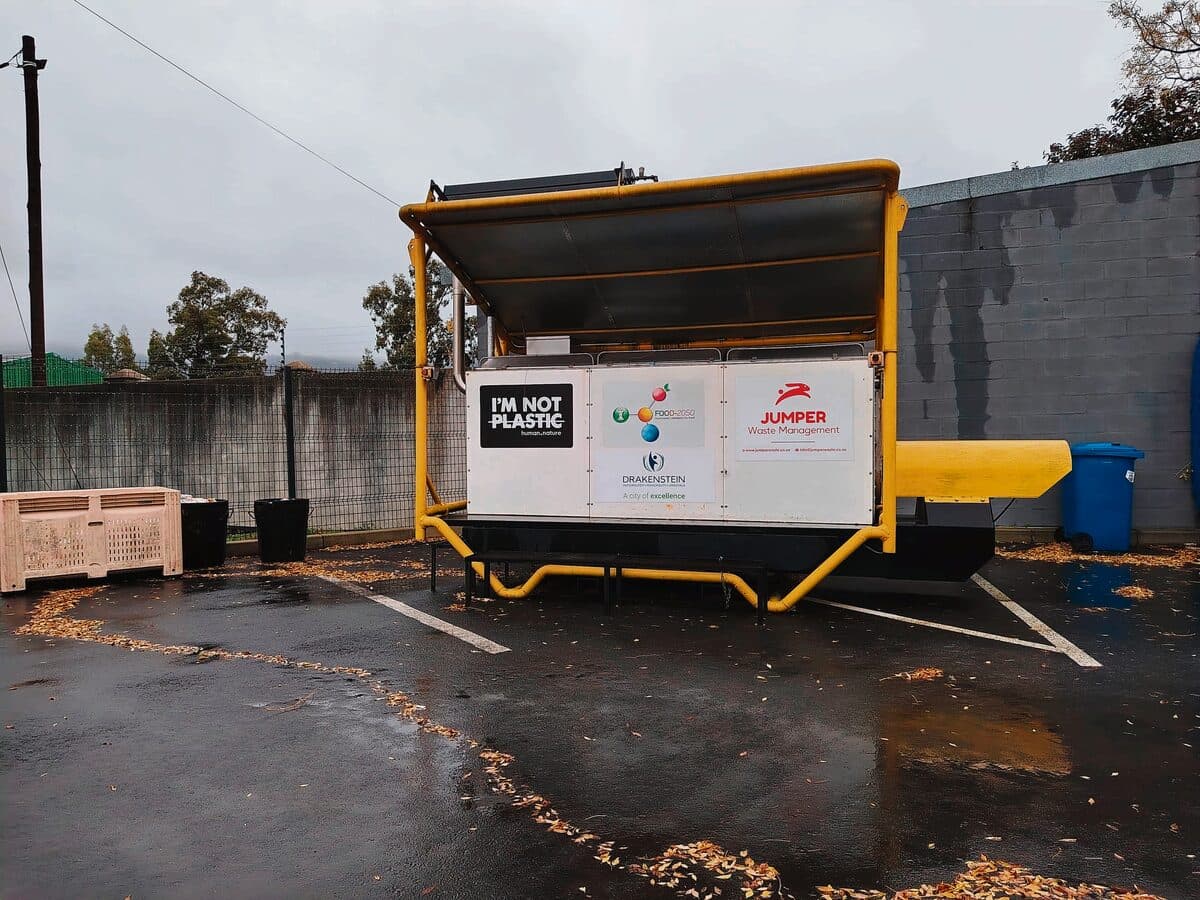
Food2050 aerobic composting unit

Composting / FOOD2050

Aerobic composting for dense urban waste systems.

The Food2050 aerobic composting unit has completed two years of operation at Drakenstein Municipality in Paarl, Western Cape, demonstrating a South African patented technology for converting food waste into first fermentation compost.

Paarl Post context

Why it matters

Food waste needs a city-compatible solution.

The Drakenstein Municipality waste bylaw proposal identifies both single-use plastics and organic waste diversion as priorities. Paarl Post reported that Food2050 is being used at the refuse transfer station in Distillery Street, Paarl to process separated food waste into a soil enhancer instead of sending it to general waste.

I'm Not Plastic supports practical systems that reduce single-use materials and prevent organic waste from becoming a landfill liability.

Food2050 aerobic technology

Economic and environmental advantages

  • Operational expenditure is already cheaper than gate fees at landfill sites.
  • The first fermentation compost product has a comparative commercial value of 10 times that of matured cow manure.
  • It is a 100% aerobic process, with water vapor and biogenic CO2 as by-products.
  • Food waste mass is reduced by 80-85% into first fermentation compost.
  • The unit is a continuous process: it accepts food waste input while discharging first fermentation output.
  • It can be deployed within urban areas, reducing collection and transport costs for hazardous waste streams.

Windrow composting limits

Why dense areas need another model

  • Food waste has high moisture content and can become anaerobic without sufficient bulking and aeration, producing odor, methane, other greenhouse gases, and toxic effluent.
  • Large open land areas are required, which is difficult for urban and space-constrained locations.
  • Poorly balanced feedstock can attract flies, rodents, and other pests.
  • Outdoor systems are exposed to rainfall, wind, and temperature fluctuations.
  • Regular turning with machinery such as windrow turners and tractors is required.
  • Buffer zones are normally needed around residential and commercial areas due to odor and noise.
  • Windrows normally take several weeks or months depending on material and management.